COMPACT HANDOFF
Custom AC server rack fields on one sheet
- Heat the cabinet must remove, in watts or kilowatts, as a buyer figure.
- Supply voltage and phase for the cooler, not for the servers.
- Condensate path: internal tank, drain, or unknown.
- Ambient high and low the unit should see.
- Door style: solid with a cooler, or perforated without one.
- Indoor row or outdoor pad, plus any ingress protection code to request.
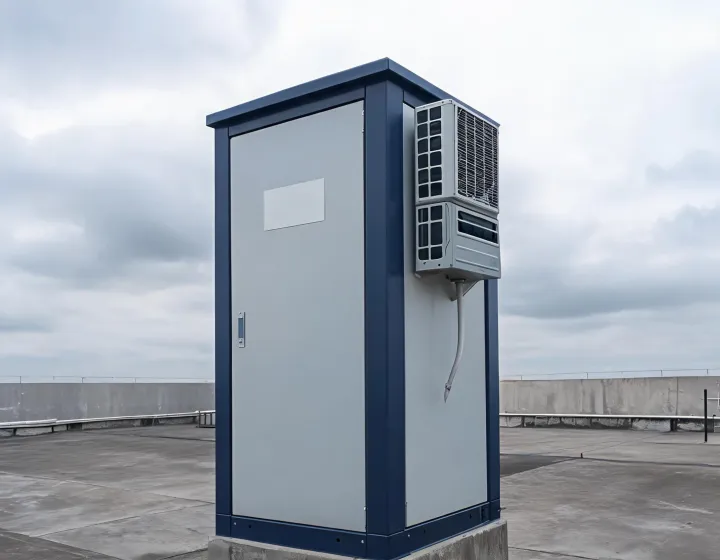
Evidence to bind to the cooler, not to the family name
A custom AC server rack is a cabinet plus a cooling machine. The steel drawing and the cooler datasheet are different documents. Ask the supplier to name both model codes. A photo of a side pod does not state capacity.
| Field | Write this | Do not assume |
|---|---|---|
| Heat load | Sum of equipment watts you calculated, or "unknown" | That a 1 kW or 2 kW pod matches your sum |
| Voltage | 208 V, 230 V, or another figure, single or three phase | That the cooler shares the server PDU |
| Air path | Internal loop or fresh air, and filter access | That a perforated door plus a cooler is a coherent plan |
| Condensate | Drain location or a tank and a pump | That an indoor closet can take a drain |
| Ambient | Highest outdoor or room temperature you will accept as the design point | A catalog rating at 35 C applies at 45 C |
| Envelope | Ingress protection code to request, if outdoor | Any IP code this desk might invent |
Rack units still describe the internal rails. A climate cabinet can be 24U, 32U, or 42U internally while the external height grows because of the pod and the plinth. Measure external height against the pad or the doorway. The 19 in opening can remain EIA-310 while the skin is wider than 800 mm to hold the cooler. Record that external width in millimeters.
Load rating must include the cooler mass. A buyer requirement of 800 kg static on the cabinet alone is incomplete if the pod adds mass the slab or the wall sees. Say which number is steel-only and which number is installed. Measurement accuracy is a scale or a published mass on the cooler nameplate, not a guess from the photo. Calibration traceability is relevant only if a supplier cites a cooling test bench. Ask for the condition: watts, ambient, and voltage.
This handoff does not size the cooler. It does not state a resulting room temperature. Runtime, efficiency, and outlet count belong to UPS or strip purchases. Switching capacity and optical budget belong to the network gear inside. Connector mating cycle counts do not describe the cooler connector; if the power inlet matters, ask for the inlet type by name, such as a hard-wired junction or a stated plug.
Trade-offs before you accept an alternative pod
Solid door with a cooler versus perforated doors in a contained aisle
A solid-door climate cabinet recirculates air across a heat exchanger. That plan can suit a dusty room or an outdoor pad, and it fails if the cooler capacity is below the equipment watts you add later. A perforated cabinet in a contained hot aisle moves heat to the room system. That plan can suit a row that already has CRAH capacity, and it fails if you expected the cabinet itself to be the air conditioner. Suppliers sometimes offer the other door as a substitute because the rail count matches. Treat the door and the cooler as one decision. Do not let a matching 42U number hide the swap.
New climate cabinet versus a refurbished shell with a replacement cooler
A new envelope can align the gasket, the finish, and the cooler warranty on one purchase. A refurbished shell can be the practical path when the pad and the footprint already exist and a new skin will not fit. The refurbished path needs the remaining structure described, plus whether the replacement cooler is new. Those are opposing supply choices, not a quality slogan. Mark the choice on the brief so a unit-price gap is explained by condition.
Standard pod versus a compatible cooler from another line
A factory-standard pod is documented against that cabinet model. A compatible cooler from another line may fit the cutout and still differ in voltage, condensate fitting, and control alarm. The standard side is narrower to source and easier to document. The compatible side can replace a discontinued pod when the cutout is measured. Ask for the cutout drawing in millimeters either way. This is the cabinet version of an exact-fit versus alternate-fit decision. It is not an argument about coded optical modules.
The condensate plan is set by the cooling path and the cabinet skin, not by the equipment you rack later. If a supplier offers a shorter cabinet to "make the price work," check usable rack units against the chassis list before you treat it as the same custom AC server rack.
Hand off the six fields
Use the form for heat load, voltage, condensate, ambient, door plan, and indoor or outdoor placement. Quantity and US destination sit in the same box. A drawing of the pad can follow by email. This screen has no upload control.
Related labels live on the enclosure rows. A height dispute that is not about cooling belongs on the 4U price path.